| Task
Group |
|
Operations |
Date |
| |
|
|
|
| |
|
|
1944 |
| |
|
|
|
| TG 22.7 |
|
Dep Norfolk, VA for
Cape Verde Islands |
28 Sep |
| |
|
Arrv Port Royal Bay,
Bermuda |
30 Sep |
| |
|
Dep Port Royal Bay,
Bermuda (for ASW exercises) |
1 Oct |
| |
|
Arrv Port Royal Bay,
Bermuda (for replenishment) |
5 Oct |
| |
|
Dep Port Royal Bay,
Bermuda (for ASW operations) |
5 Oct |
| |
|
Arr Ponta del Gada,
Azores (for replenishment) |
30 Oct |
| |
|
Dep Ponta del Gada (for
ASW operations) |
30 Oct |
| |
|
Rtn Norfolk (for repairs
and alterations) |
06 Nov |
| |
|
Dep Norfolk for Baltimore,
MD |
26 Nov |
| |
|
Arrv Baltimore (for
leave, liberty and recreation) |
27 Nov |
| |
|
Dep Baltimore |
29 Nov |
| |
|
Arrv Norfolk |
30 Nov |
| |
|
|
|
| Units:
USS Guadalcanal, VC-69, USS Pillsbury, USS Chatelain, USS Pope,
USS Flaherty, USS Neunzer, Destroyer Division 4 in USS Pillsbury |
| |
| Results:
U-170 attacked - escaped undamaged, Severe storm damage sustained
by TG |
| |
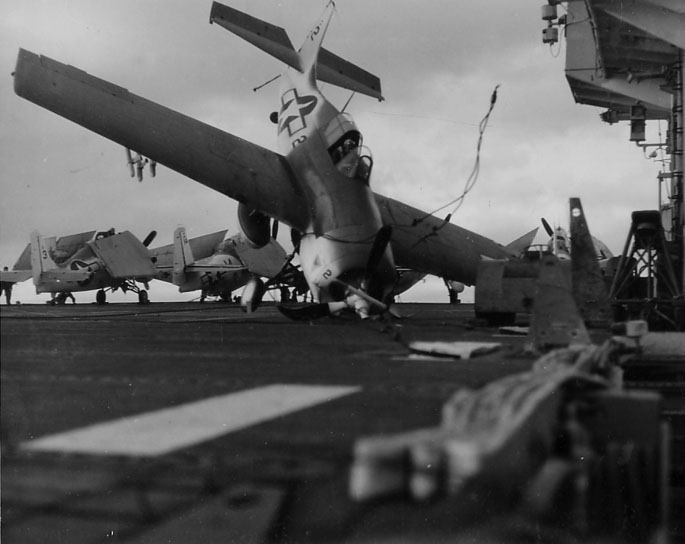 |
Crash of F4F VF #2
Bu 55643, pilot LTJG R. K. Johnson, 11 October 1944
|
|
|
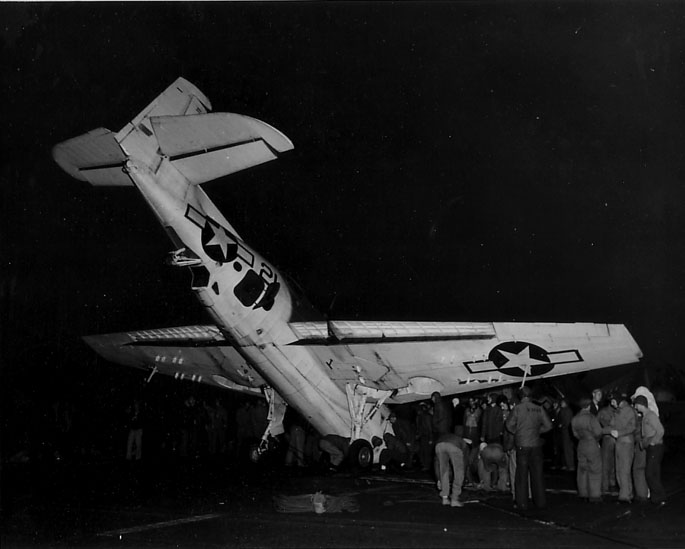
Night
crash of TBM VT #21 Bu 46374, pilot LTJG W. D. Gordon, 11 October
1944
|
| |
|
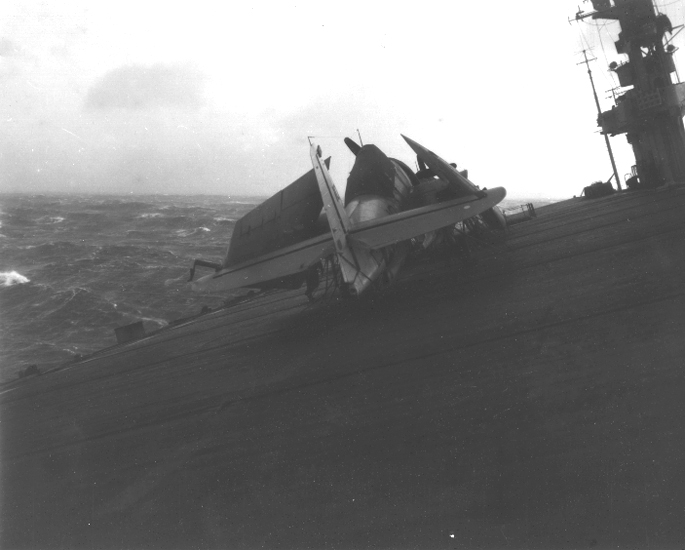 |
Gale
and hurricane weather, 17 October 1944. Seas were exceedingly
high in the morning and increased to mountainous in the afternoon.
The winds averaged 48 knots, but as high as 70 knots were recorded.
Barometer lowest reading was 28.61. The ship rolled and pitched
constantly, steering was difficult, engines were used to help
steer the course. |
| |
|
 |
Gale
and hurricane weather, 17 October 1944. Seas breaking over the
bow. |
| |
|
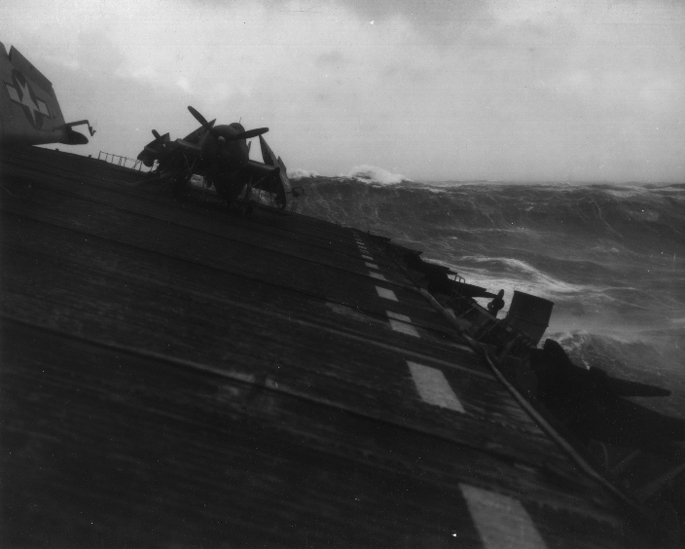 |
Gale
and hurricane weather, 17 October 1944. Looking aft. |
| |
| The
Big Storm |
| Task
Group 22.7 left Norfolk headed east on Sept. 28, 1944 for the open
Atlantic on another sweep looking for submarines. On this cruise
the DEs Pillsbury, Pope, Flaherty, Chatelain, and Neunzer accompanied
us. Our usual sweep pattern took us east to Bermuda and onward bending
southerly where we usually encountered warm weather and moderate
seas. On this cruise we turned north out of Bermuda. We reached
Bermuda on the 30th of September and left the next morning. However
we were back in Bermuda a day or two later and departed again on
the 5th of October. The engineers were having trouble in the engine
room and this time we sailed on one engine while a condenser failure
was repaired at sea. |
| By
the 16th of October we had reached Latitude 57 deg, 57 min N, and
Longitude 34 deg, 26min W which was about as far north as the ship
had ever sailed. That morning the wind was building and gusts to
56 kts were measured. Dark scudding clouds obscured the sun and
by noon it looked like night and we secured from flight operations.
|
| The
noon meal was to prove an unforgettable experience. The ship was
rolling hard. Down in the mess hall we went through the chow line
and, carefully balancing mess trays, made our way to a seat at the
tables. The tables were arranged so that they were aligned athwartships.
It was really funny at first. As the ship rolled, every man would
hold one end of his tray, picking it up so as to keep the tray level
while forking food with the other hand. As the roll to the other
side started, everyone quickly switched hands and the operation
was repeated. Actually you could eat pretty good once you got the
timing figured out and the meal was progressing in good shape. Then
a roll to port began that felt like it would never end. As everyone
hung on for dear life, one of the mess tables collapsed. Men, table,
and benches went hurtling across the deck to smash into the opposite
bulkhead. On the opposite roll they all came skidding back on a
deck now well greased with mashed potatoes and gravy, jello, hot
coffee and salad greens. Picking up speed, men, tables, benches,
and food crashed into the tables on the other side causing more
tables to collapse. What started out as merely funny, was fast becoming
pretty serious. The laughing turned to curses mixed with groans.
Everyone was down on the deck now on hands and knees and it was
almost impossible to stand up. As a table and its load of men came
shooting across the deck, those on the other side scrambled frantically
trying to get out of the way. All the tables came down and people
were getting bruised as they slammed into the bulkheads. The deck
was covered with men, overturned tables and benches, and the whole
mess liberally covered with spilled food. Those of us who had come
down from the flight deck decided it would be a damn site safer
topside. Extracting ourselves from the tangled mess as fast as possible,
we headed for “safety” topside. After this fiasco, the
mess hall and galley were secured for the next three days and we
lived on sandwiches and coffee. A few hands reported to sick bay
for treatment of assorted bumps and bruises. |
| The
storm continued to build for the next two days. The quartermasters
were holding 20 to 30 degrees of rudder trying to keep the ship
on base course. The storm was a spectacular sight from up on the
flight deck. The waves were huge. Green water was coming over the
flight deck 60 feet above the waterline. The ship was rolling so
hard we had to double-up on the aircraft tie-down lines and even
at that, with the lines stretched to the limit, it appeared some
of those airplanes would snap the lines and slide into the catwalks.
The wind was blowing so hard aircraft propellers were actually turning
in the wind; not spinning, but hitching around in little jerks.
Ordinarily it took two men pulling hard on a propeller tip to turn
one of those engines over. |
| The
ship would struggle to rise on the crest of a wave only to fall
off into a trough and the only sight was of mountainous waves all
around higher than the deck. Nosing into a wave, the bow would begin
to rise, water cascading off the deck. Stuck on the face of a huge
wave the ship would come to a halt and slide backwards, completely
burying the 5-inch gun mount on the fantail. The vibration caused
by the ship sliding backward against the thrust of the propellers
shook the hull like a dog with a bone in its teeth. The expansion
joints in the flight deck were gaping far beyond anything seen before
as the hull was wracked by the waves. The combination of wind and
rolling made it almost impossible to move around; we were just too
busy hanging on. |
| The
DEs were having a rough time of it also. They were cocky little
ships and good company for the business we were in. As we watched
from the catwalks, a DE would nose into a wave and go out of sight
with just a bit of the bridge and the radar mast sticking out. As
we stood watching and wondering if they would ever come up again,
the wave would roll on by and the little ship would come rearing
up, the water cascading off her decks, only to repeat the process
with the next wave. Those guys should have been drawing submarine
pay; they were under the waves as much as they were on top. |
| Down
on the hanger deck, the side plates between the flight deck and
hanger deck began to fail. Huge cracks in the plates would open
and close as the hull wracked and twisted. When the edges of a crack
would momentarily close up, a shipfitter would throw a fast tack
on it with his welding rod hoping to pin the crack but it was a
losing proposition. On the next heave of the hull the weld would
let go with a loud crack and the tear would continue on up the plate.
Water began spurting through the cracks onto the deck. |
| The
storm continued the next day building in intensity. Wind gusts were
reaching 75 kts and waves were estimated to be about 60 ft high.
Finally, the hanger deck doors off the fantail gave way and water
began washing in on the hanger deck. The aft elevator pit flooded
and filled with seawater like a swimming pool. |
| Sleep
was hard to come by. The rolling was so intense we had to strap
ourselves into the bunks to keep from being tossed out. This storm
lasted for three days. The Task Group could do nothing but ride
it out. Finally by noon of the third day the wind began to abate
and the seas moderate. It was time to take stock of our situation.
It turned out considerable damage had been done. The hull had cracked
and admitted seawater to the boiler feedwater tanks. The feedwater
was now contaminated and could not be used to make steam. The ship
was forced to run on what water could be made with the evaporators
and the engines demands came first. Fresh water was in short supply.
Seawater was supplied to the heads and we had our first experience
showering in salt water. It wasn’t too bad if you dried quickly
so the water didn’t leave salt deposits on the skin. Of more
concern was the drinking water. The scuttlebutts were turned off
except for ten minutes every hour. The galley was still shut down
and sandwiches began to get tiresome but no one had to go hungry. |
| Some
liferafts had been swept away and the anchor windlass electrical
circuits were out. It appeared the 5” gun mount was damaged
and the hanger deck bulkhead doors to the fantail needed repairing.
There were numerous cracks in the hull and flight deck structures
but by late that afternoon, the ship was able to resume flight operations
and we headed for Ponta Delgada, arriving on the 30th of October.
After refueling we headed back to Norfolk where the ship went into
drydock for a month of repairs and the crew went ashore for a little
rest and relaxation. |
| [Note:
Guadalcanal’s experience in the North Atlantic was typical
for the Casablanca-class carriers. These ships were notorious “rollers”
and were considered to be unstable. The Bogue-class carriers fared
better in heavy seas; they had been modified with 2000 tons of concrete
poured into the bilges. They were slower however, and aircraft handling
was more difficult due to their cambered hangar decks. By the end
of 1944, all the Casablanca-class carriers, except Mission Bay,
were reassigned to duties which took them off patrols into the North
Atlantic.] |
| ...Donald
M. Baker ABM1/c, USS Guadalcanal |
| |
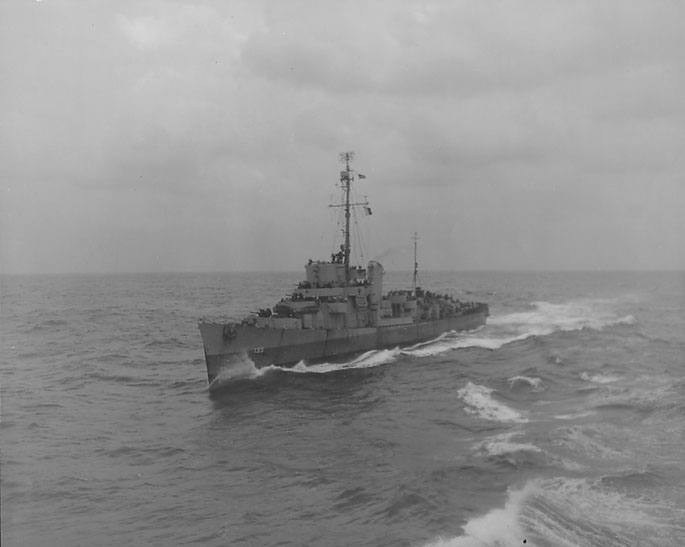 |
USS
Flaherty, October 1944 |
| |
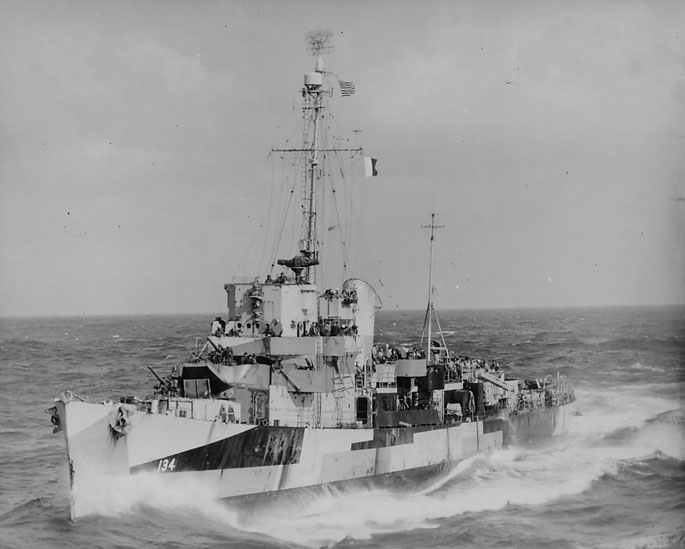 |
USS
Pope, October 1944 |
| |
|
|
USS
Neunzer, October 1944 |
| |
|
|
Crash
of VF #7 Bu 16584, 18 October 1944 |
| |
|
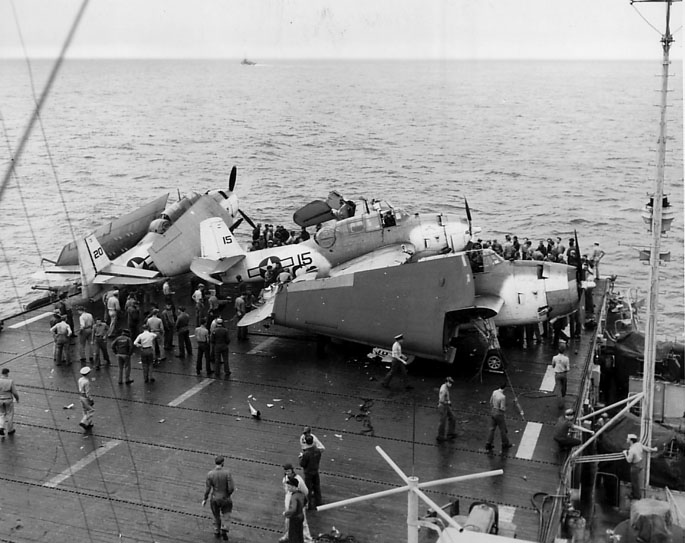
Crash
of TBM VT #15 Bu 25481, 26 October 1944. The TBM made a normal
landing and caught the number 4 wire, but hurdled the barriers
as the tail hook pulled out of the plane. VT #15 smashed ahead,
then knocked VT #12 off the starboard bow into the sea. Pushed
VT #14 forward on to the forecastle and wrecked VT #21. No personnel
were injured.
|
| |
|
|
Shoreline
of Ponta Delgada from the flight deck of USS Guadalcanal, 30 October
1944
|
| |
 |
VC-69
Officers on the flight deck of the USS Guadalcanal, November 1944 |
| |
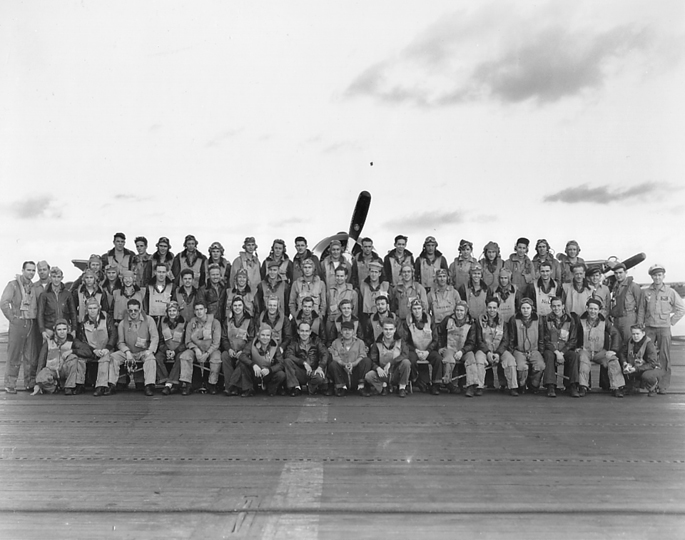 |
VC-69
Enlisted flight crew on the flight deck of the USS Guadalcanal,
November 1944 |